
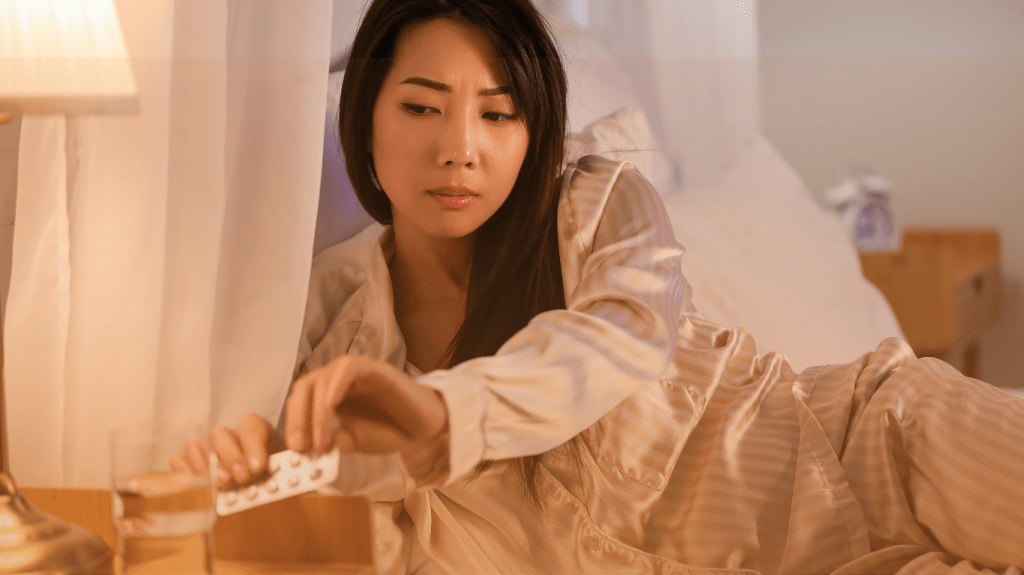
For the love of all that is holy, I just want to sleep.
Written By: Diana Alvarado, Certified Menopause Coach
Not eight perfect hours. Not some optimized sleep cycle tracked by a ring on my finger. Just to be able to sleep through the night, without waking up at 3am remembering a conversation from 2022.
So naturally, I went down the the google rabbit hole. I would find supplements like Magnesium, Melatonin, Ashwagandha, Tart cherry juice, and a $47 supplement with a name I cannot pronounce. I have seen it all in my feed, and I have a lot of thoughts about this.
I’m a big believer in what the research says. And what it says is a lot more nuanced than what most Instagram accounts are telling you. The sleep supplement market reached $68 billion in 2025. That is a lot of money being spent on products whose evidence, in many cases, is thinner than you’d hope. So let’s actually look at what we know.
First, why sleep in perimenopause is its own category
Before we get into supplements, this part matters. Sleep disruption during perimenopause is not the same as regular insomnia, and what works for one may not work for the other.
As estrogen and progesterone shift, your sleep architecture changes. These hormones support melatonin production, help regulate body temperature through the night, and interact with the stress response system. When they fluctuate, your sleep becomes more fragile, so you may fall asleep fine and then find yourself wide awake at 3am for no clear reason. That pattern is specific to this transition, and it’s worth understanding because it changes what kind of support is actually useful.
What melatonin actually does — and what it doesn’t
Melatonin is the most popular sleep supplement out there, and also one of the most misunderstood. Your body produces it naturally when light drops in the evening. It tells your body that night has arrived.
Supplemental melatonin has two specific uses that research supports, helping you fall asleep, and fine tuning your internal clock, which is useful for jet lag, shift work, or if your natural sleep timing has shifted later than you’d like. If you’re waking up repeatedly through the night, melatonin is addressing the wrong part of the problem. It works at the front end of sleep, not the middle.
Mayo Clinic’s guidance is that melatonin is safe for short-term use, and most clinical guidance currently points to one to two months as a reasonable window for short-term use in adults, with insufficient data on nightly long-term use beyond that.
A 2026 meta-analysis that specifically looked at melatonin supplementation in menopausal women did find some improvements in sleep quality and menopausal symptoms. So it’s not without value — but it is worth being specific about what you’re trying to fix before reaching for it.
There’s also a quality problem worth knowing about. A 2025 survey found wide variability in label accuracy across melatonin products, what the label says and what’s actually in the bottle are often different. And higher doses are not better, research consistently shows that smaller amounts are often more effective, and larger doses can actually make things worse. (those gummies you find on the pharmacy shelf have much more than the recommended 1-3 milligrams)
Magnesium
Magnesium became the sleep supplement of the moment in the early 2020s and it’s still everywhere. The honest answer is: the evidence is mixed, and the form matters.
A 2025 randomized trial found that magnesium bisglycinate improved sleep quality in adults reporting poor sleep — participants fell asleep faster and woke more rested. That’s a genuinely promising finding. Research into how magnesium specifically impacts sleep disorders is still developing, and experts haven’t yet pinned down the exact mechanisms.
What this means: magnesium is one of the more researched options with some decent trial data behind it. But “some evidence” and “this will fix your perimenopause sleep” are very different claims, and most of what you’re seeing on social media is the latter.
If you’re curious about whether it’s right for you, that’s a conversation worth having with your doctor, not something to decide based on an evening routine video.
The other common ones
Ashwagandha, L-theanine, tart cherry, valerian root — these all show up regularly in sleep supplement content. A 2025 meta-analysis found that even the ones with research behind them are showing modest results, not dramatic ones. They are not doing nothing. But they are also not the fix that the $47 price tag implies.
What the research actually supports for perimenopause sleep
This is the part that tends to get missed, possibly because it’s harder to sell.
Cognitive behavioural therapy for insomnia — CBT-I — is consistently what the evidence points to as the most effective treatment for chronic insomnia, including in perimenopause. Ontario’s Quality Standard now states that everyone with chronic insomnia should receive CBT-I, that’s a pretty big statement. It’s formally being recognized as the first-line treatment over medication, over supplements, over sleep hygiene checklists alone.
CBT-I works by addressing the thoughts and habits that sustain insomnia over time — not just what you do at bedtime, but how you think about sleep, and what you’ve built up around it. It takes a few sessions with a trained provider and the results tend to hold longer than any supplement.
I realize that’s less exciting and more time consuming than a gummy you take before bed. But this is what the research actually shows.
So where does this leave you?
Here’s my honest take, and it’s the same thing I say to the women I work with:
Supplements are not nothing. Some have real research behind them and may be worth exploring with your doctor, particularly if you’ve already addressed the foundational stuff. But they are also not the place to start, and they are not a substitute for understanding what’s actually driving your sleep disruption in the first place.
Before you spend another dollar on a supplement, it’s worth asking: have you looked at your caffeine timing? Your light exposure in the morning? What’s happening in your nervous system during the day that follows you into bed at night? These things don’t come in a bottle, and they tend to matter more than anything that does.
Perimenopause makes sleep harder, that’s real, and it’s not your fault. But the most effective tools for it are also the least glamorous ones.
If you want more tips on how to improve the outcome of your sleep, subscribe to my monthly newsletter CLEAR LIVING HERE


Leave a Reply